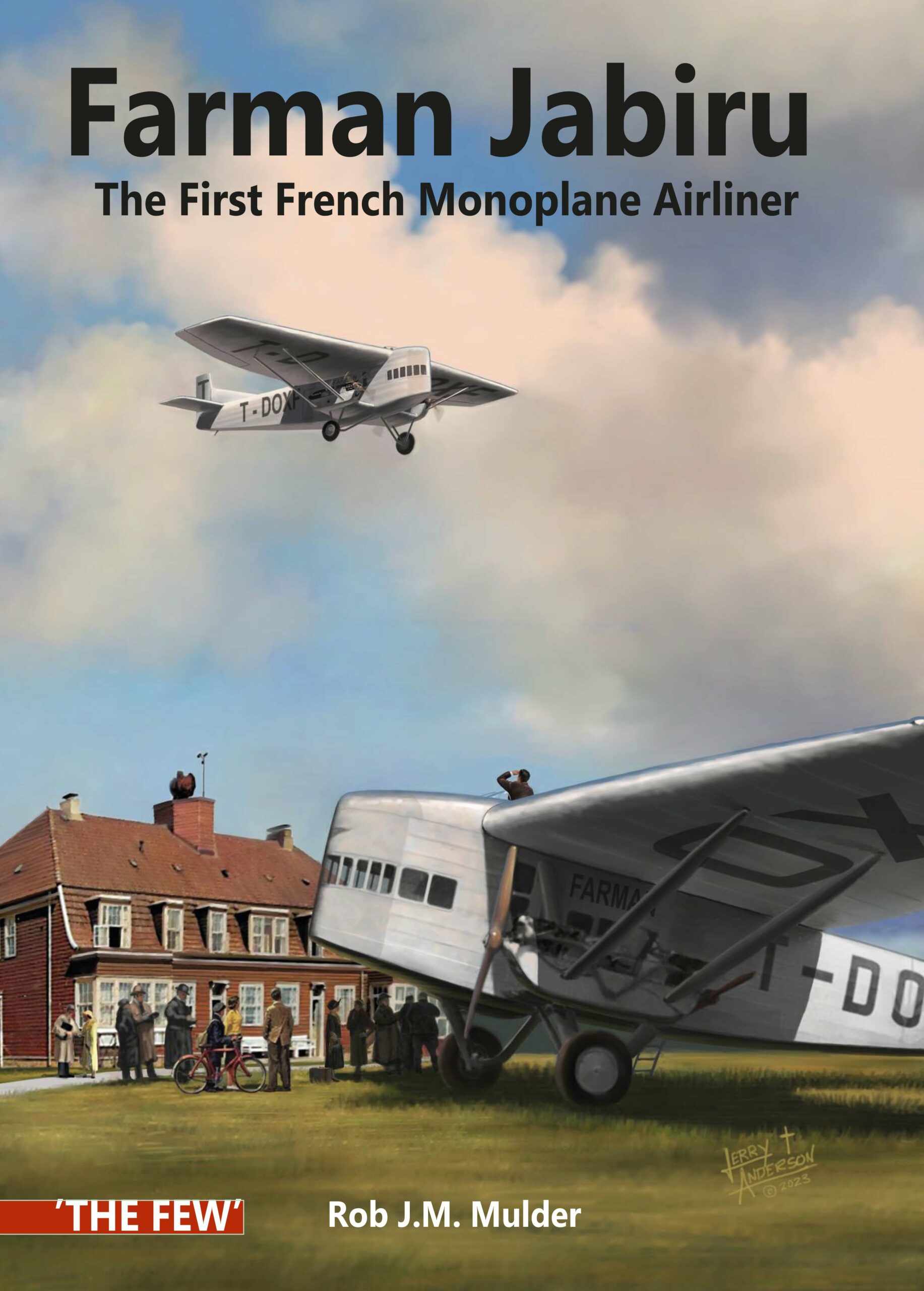

“The Few” is a series devoted to airliners produced or operated in limited numbers, often tied closely to a specific airline or niche role in early commercial aviation. These aircraft, though few in number, frequently played outsized roles in shaping airline operations and technological development. This volume focuses on the Farman Jabiru family—recognized as the first French monoplane airliner series.
The story begins with the Farman F.3X Jabiru (later redesignated F.121), which first flew in September 1923. In the same month, it demonstrated its capabilities by winning the prestigious Grand Prix des avions de transport. This four-engined aircraft represented a significant step forward in French civil aviation, combining payload capacity with improved reliability. It soon entered service with Société Générale de Transport Aériens (SGTA–Lignes Farman), operating on the Paris–Brussels–Amsterdam route and later also extending services to Cologne and Berlin.
Alongside the F.121, SGTA–Lignes Farman also employed the single-engined F.170 Jabiru across its network. Both types remained in service until they were superseded by more advanced and economically viable aircraft such as the F.190 and F.300 series, reflecting the rapid pace of technological progress during the 1920s.
A parallel development emerged with the Compagnie Internationale de Navigation Aérienne (CIDNA), which operated a three-engined variant known as the F.4X Jabiru (later F.120 T). This version expanded the Jabiru’s reach across Central and Eastern Europe, serving routes to Switzerland, Czechoslavakia, Austria, the Balkans, and Poland. The adaptability of the Jabiru design led to further evolution into both civil and military derivatives, underlining its importance as a transitional type in aviation history.
In Scandinavia, interest in the Jabiru culminated in its evaluation by Det Danske Luftfartselskab A/S (DDL, Danish Air Lines). Following a demonstration flight in May 1925 and subsequent trials in September, DDL ordered four Farman F.121 Jabirus to support its expanding route network, including a new service from Copenhagen via Hamburg to Cologne. Notably, two of these aircraft were constructed under license at the Danish naval shipyard, Orlogsværftet, marking an early example of localized aircraft production in Northern Europe.
Despite its promise, the Jabiru proved less successful in Danish service. Operational challenges and relatively high operating costs made it less competitive, and it was gradually replaced by the more efficient single-engined Fokker F.VIIa. This transition illustrates a broader industry shift toward simpler, more economical aircraft designs during the latter half of the decade.
This book chronicles the operational history of the Farman Jabiru with SGTA–Lignes Farman, CIDNA, and DDL from 1925 onward. Drawing on extensive archival research, it is richly illustrated with more than 300 photographs, supported by detailed tables and carefully rendered colour profiles. Together, these elements provide a comprehensive portrait of a pioneering yet often overlooked airliner family that helped define early European air transport.
The book has an introduction by Pierre Farman, grandson of Dick Farman.
Book reviews:
Jean-Noël Violette – Aérobibliothèque (French), 18 August 2026
Ben Dunnell – Aeroplane August 2026